Apparel manufacturers in Guangzhou: what a sample costs, how long it takes, and who to ask.
Guangzhou is the largest garment market in the world by volume, and almost all of the buying starts in the same place: a fabric market, a sample, and a conversation about how many pieces a factory will take. The city is organised in layers. Zhongda fabric market supplies the cloth. Shisanhang and Shahe move finished stock in bulk. The factories themselves sit in Haizhu, Panyu, Baiyun and Zengcheng, and in Foshan and Dongguan within an hour. A company you meet in a wholesale building is very often a trading office for a plant in one of those districts, which is not necessarily a problem — but you should know which one you are talking to, because it changes who owns the sample, the price and the risk. This page is about how that system actually works, and what to check before you commit to a production run.
Send the style — US$1,000 Or WhatsApp us
US$300 per product, one-time. One factory that can make it, visited in person, one page each. If neither can build it, the fee comes back.
What the work gives you
- One factory that can make your style, with their names and addresses. You buy from them directly; we are not in the order.
- A one-page PDF report for each: the address we went to, which operations happen in-house and which are put out, the machines we saw, photographs taken on the day, and the date of the visit.
- Unedited video of the cutting and sewing floors, not a promotional clip.
- A named contact at each factory, and a plain statement of whether we believe it is a plant or a trading office.
What we do not do. We do not test, grade or certify anything. We do not quote a price and we do not guarantee delivery. We report what was at the address on the day.
How the Guangzhou trade is organised
The first thing to understand is that "factory" in this market covers three different businesses, and they are easy to confuse because they all answer the same messages.
There is the plant: it owns sewing lines, cutters, maybe its own printing or embroidery, and it takes orders from buyers. There is the workshop: smaller, often specialising in one operation such as knitting, dyeing, washing or finishing, and usually working for other factories rather than for buyers. And there is the trading office: it has a showroom, a few merchandisers, and a network of workshops it places work with.
None of these is dishonest. The problem is that a trading office will often present itself as a factory, and the difference only becomes visible when something goes wrong — because a plant can fix its own production, and an office can only ask someone else to.
The second thing to understand is that most garments are made by a chain rather than by a building. Fabric from Zhongda, cutting in one workshop, sewing in another, washing in a third, finishing and packing somewhere else. A company can be entirely legitimate and still control only one link. That is why the useful question is not "are you a factory" but "which of these operations happen here, and which do you place elsewhere".
The third is that capacity is seasonal and lumpy. Factories fill up before the major buying seasons and are quiet afterwards, and a factory that has time for you in a quiet month may not have time in a busy one. Asking what else is on the floor when you visit is a fair question, and the answer tells you more than the capacity figure on a quotation.
What we look at on the floor
We ask, before we go, which operations your style needs, and then we check which of them happen at that address.
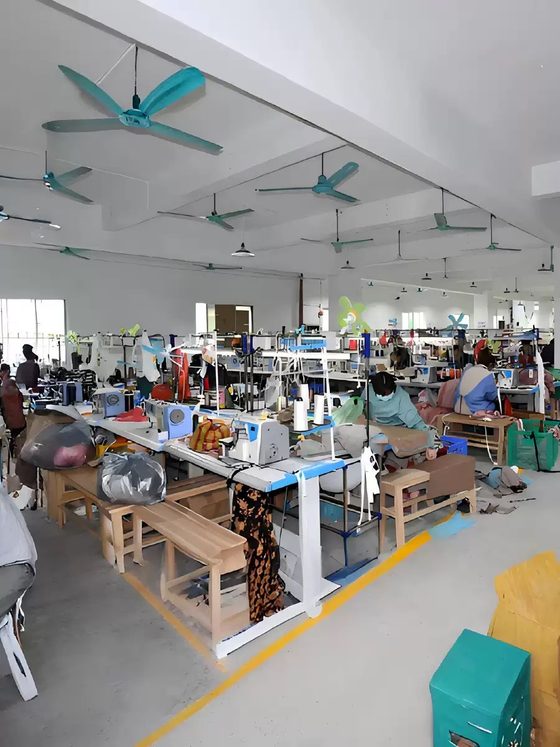
For a sewn garment that means the cutting table and the cutting method — a straight knife, a band knife, a die press — because the set-up tells you what kind of runs the plant is built for. It means the sewing floor: the machine types, the number of lines, and whether the units on the tables resemble yours. It means the finishing and pressing area, which is where a lot of small factories are thinnest.
We ask about the operations that are easy to claim and hard to own: printing, embroidery, washing, dyeing. If a factory says it prints, the printing should be in the building or in a named workshop it uses, and the answer should be specific. A vague yes is usually a no.
We look for the sample room and ask who works in it. A plant that has a pattern maker and a sample machinist on its own payroll can develop a style; one that does not will send your tech pack out and charge you for the round trip.
We check the licence and the registered scope against what the company says it does, and the address against the premises we walked into. We ask how many people are on the floor and what the current order book looks like, and we photograph the floors with the capture time intact.
We are explicit about what this is not: it is not a quality inspection, and it is not a judgement about whether the garments are good. It is a dated record of what the plant is.
Where apparel sourcing goes wrong
The first trap is the sample that was made somewhere else. Sample rooms in this market are often better equipped than the production floor, and sometimes a sample is made by a specialist workshop rather than by the factory quoting you. The sample can be perfect and the production can be nothing like it. Asking who made the sample, and on which machines, is the question that separates the two.
The second is MOQ quoted as a single number. Garment minimums are usually per style, per colour, and per fabric, and they are set by the fabric mill as much as by the sewing floor — a fabric with a custom dye lot has a minimum of its own. A buyer who is quoted "300 pieces" and then discovers it means 300 per colour across three colours has been given a number that was true and useless.
The third is the price that excludes what you will actually pay: the sample charge, the pattern and grading, the fabric deposit, the printing plates, the wash test, the shipping. Garment quotations are frequently a sewing price rather than a landed cost, and comparing two of them without the rest is comparing nothing.
The fourth is timing. A garment factory's calendar is driven by the retail calendar, not yours, and the month before a season is the worst month to ask for a favour. Buyers who plan backwards from a delivery date rather than forwards from an order date lose less money.
Samples, MOQ and lead times
The normal sequence is: style and fabric selection, a quotation against both, a sample, sample approval, sometimes a fit or a pre-production sample, then production, inspection and shipment.
Sampling in Guangzhou commonly takes one to two weeks from an agreed fabric, and longer if the fabric has to be woven or dyed. Sample charges are normal and are often credited against a subsequent order, though the credit is a negotiation rather than a rule — get it in writing if it matters.
MOQ in this trade is usually expressed per style, per colour and per fabric, and the binding constraint is often the mill rather than the sewing floor. Stock fabric can allow a smaller run; a custom dye lot usually cannot. If your quantities are small, the practical route is a stock fabric from Zhongda and a workshop that specialises in short runs, not a large plant asked to break its own rules.
Production lead time is usually quoted in weeks from sample approval and fabric in-house. Sewing itself is often quick; waiting for fabric is what takes the time. Port congestion and vessel schedules then add their own delay, and the shipment window in the weeks before a major holiday is genuinely tighter than it looks.
Shipping is from Shenzhen, Guangzhou or Foshan, and the documentation is standard. As with electronics, the risk is not the paperwork. It is that the goods are not what the sample was, which is why buyers arrange an inspection before shipment — and why we are explicit that we are not that inspection.
Where the fee applies. Everything within 150 km of our Guangzhou base is included: Guangzhou, Foshan, Dongguan, Shenzhen, Zhongshan and Zhuhai. Beyond that we add a travel supplement, agreed in writing before we set off — Huizhou and Jiangmen +US$100; Yangjiang, Shaoguan and Chaoshan (Shantou, Chaozhou, Jieyang) +US$200. At present we work within Guangdong only. This visit is inside that radius.
Garment sourcing in Guangzhou rewards buyers who understand that they are buying a chain of operations rather than a building, and that the sample is a promise rather than a proof.
If you have a style and you want to know which factories can actually make it, and what they do themselves, the next step is a brief. Factory finding is US$300 per product: one factory, visited in person, one page each. Verification of a factory you already have in mind is US$300. Both are fixed, quoted in writing before we travel, and we take no commission from any factory.